Material applications
WeftBeacon Procurement: turn yarn end use into purchase requirements
FREE sourcing support and up to 3% on qualified matching. Eligibility applies to qualified business buyers and is confirmed after we review your product, quantity, destination, and sourcing requirements.
Material applications
Define the reference that both parties will use for the yarn or fiber, not a marketing family name.
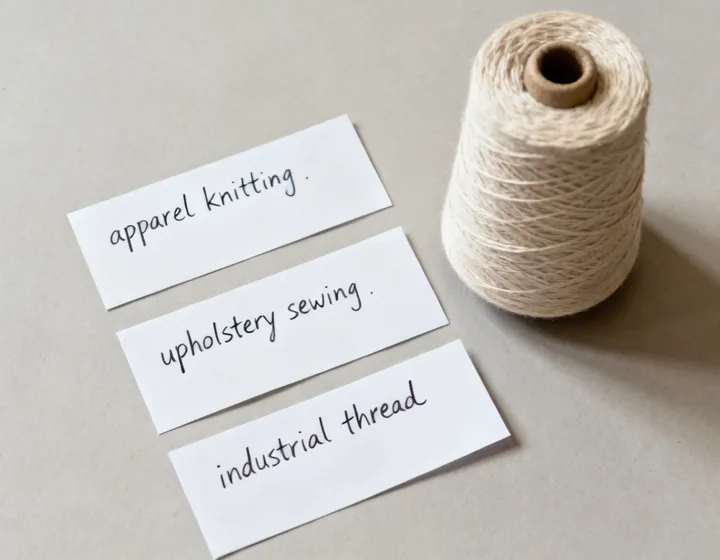
State whether the yarn feeds apparel knitting, woven shirting, upholstery sewing, outdoor equipment, industrial conversion or another named process. Exposure may include washing, abrasion, sunlight, oils or heat. Those conditions drive which tests you later request; they do not by themselves prove a mill article. Keep unknown duty cycles visible. A search that began with a third-party fiber trademark still needs your actual garment or industrial part described, because filament for airbags is not the same brief as spun yarn for jersey. Record contact surfaces, expected service environment and whether cutting, twisting or sewing follows. Stock yarn programs can shorten sampling when count, ply and package already fit; custom spinning or dyeing can match construction and finish but needs explicit minimum lots and approval dates. This page does not invent a measured keyword for every application.
If tenacity, elongation, evenness, twist, moisture or oil content matters, name the method, edition, specimen and conditioning. Yarn tensile work is commonly requested under ASTM D2256; colorfastness, pilling or abrasion belong only if the yarn will be judged after knitting or weaving. Public ASTM or AATCC listings are catalogs of methods, not results for your lot. Ask the mill to bind any report to the quoted article and date. A family brochure is useful for discovery; it is not exact-product evidence. A certificate covering another fiber family is out of scope. Sample condition should state whether the cone is greige, dyed, waxed or finish-treated, because those states change measured values. Laboratories and inspectors are chosen per order; WeftBeacon Procurement does not operate a test house.
Yarns use kilograms, tons, cones or bales rather than fabric width, but package form still changes yield. If the yarn will be woven or knitted, also record target fabric GSM, usable width and expected shrinkage so mill quotes can be compared after conversion, not only on headline kilogram price. A dye house that needs a certain cone build will reject an incompatible tube even if denier matches. Finish, spin oil and luster should be stated per end use so sewing and dyeing teams are not surprised. Lot size must cover shade or spin continuity for the production window. Lowest unit price can look attractive when freight, duties, sampling, inspection and unused yield are omitted; comparable delivered scope includes those lines. US destination, requested delivery or lead time, and whether samples travel separately belong in the same note. After those fields are listed, open the inquiry families or send the application so mills quote one scope.
Share end use, test basis, quantity unit and destination with the yarn specification.
Qualified matching may include up to 3% support. Eligibility applies to qualified business buyers and is confirmed after we review your product, quantity, destination, and sourcing requirements.
WeftBeacon Procurement is an independent sourcing partner. It is not invista and has no affiliation with or authorization from that brand.